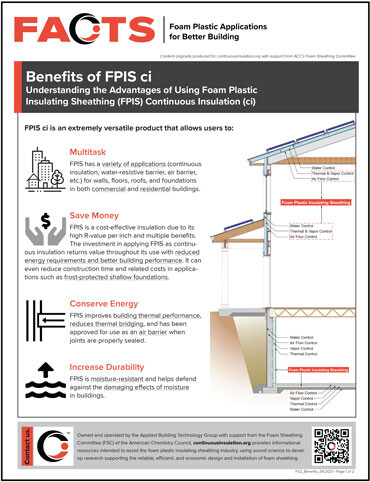
Foam plastic insulating sheathing (FPIS) continuous insulation (ci) is a multifunctional building envelope solution that delivers benefits well beyond thermal performance. Used in residential and commercial walls, roofs, floors, and foundations, FPIS can serve multiple building enclosure functions while improving energy efficiency, moisture management, durability, occupant comfort, resilience, and sustainability.
Key Takeaways
- FPIS continuous insulation provides multiple building enclosure functions, including thermal insulation, air barrier, and water-resistive barrier applications.
- Continuous insulation improves whole-wall performance by reducing thermal bridging and increasing energy efficiency.
- FPIS contributes to healthier, more durable, comfortable, resilient, and sustainable buildings throughout their service life.
Frequently asked questions
What makes FPIS continuous insulation (ci) different from other insulation products?
FPIS ci can perform multiple functions within a building assembly. In addition to providing thermal insulation, it can be used as part of the water-resistive barrier and air barrier systems when properly installed. Its versatility allows it to be used in walls, roofs, floors, and foundations in both residential and commercial construction.
How does FPIS continuous insulation improve building performance?
FPIS ci increases thermal efficiency by reducing heat flow through framing members, helping to minimize thermal bridging. It can also improve air sealing, reduce energy consumption, support more consistent indoor temperatures, and help buildings maintain comfortable conditions during extreme weather events.
How does FPIS continuous insulation support sustainability and long-term building value?
By reducing operational energy use, FPIS ci helps lower a building's carbon footprint over its lifetime. It also supports high-performance and net-zero building strategies, improves moisture resistance and durability, and can reduce long-term operating costs through better energy performance and building resilience.