Foam Plastic Insulating Sheathing (FPIS)—often called foam sheathing or rigid foam board—has many benefits and can deliver up to five essential building enclosure functions in one product as shown in the figure below.
(Note: All code references are to the 2024 editions unless otherwise noted.)
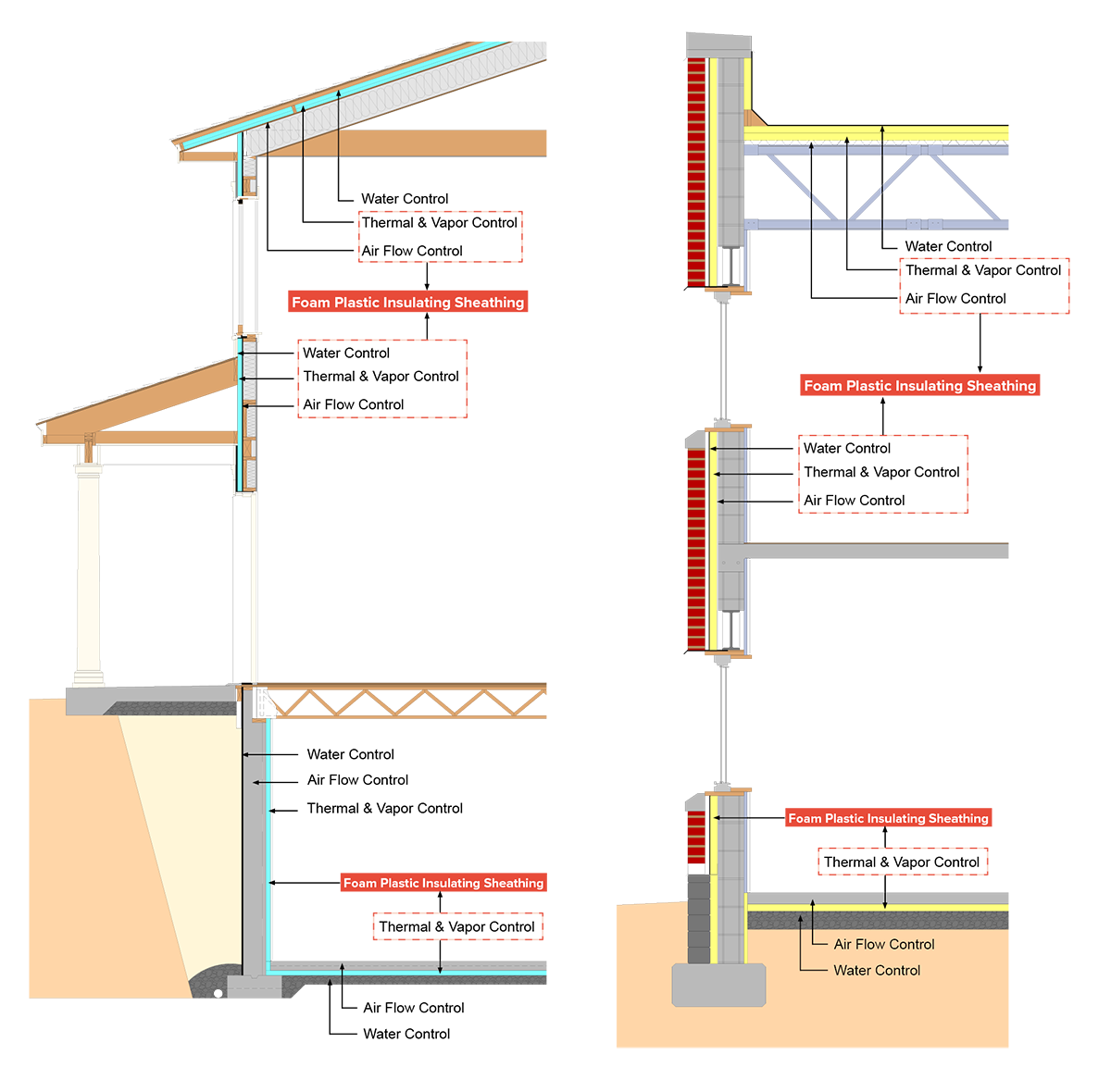
FPIS installed as continuous insulation extends without interruption across framing and other structural members to minimize the effect of thermal bridges and improve building thermal performance. FPIS ci satisfies energy code insulation requirements such as IECC Section C402.1.3 and IECC Section R402.1.3 for commercial and residential buildings, respectively. The Wood Frame Wall Calculator and Steel Frame Wall Calculator provide simple and flexible means to comply with the energy code while simultaneously addressing code-compliant water vapor control (see below).
FPIS ci provides a robust and code-compliant means of managing water vapor diffusion in all climates and all seasons when used with the right combination of vapor retarder for inward drying potential and minimum ci R-values to control temperatures inside an assembly. IBC Section 1404.3 and IRC Section 702.7—together with this 3-Step Quick Guide, the Wood Frame Wall Calculator, or the Steel Frame Wall Calculator—make it simple to find the right solution for your project.
With rigorous code-compliance testing, many FPIS products are recognized as part of a code-compliant WRB system when installed per manufacturer instructions (including specified joint tape and flashing components). While previously considered an approved alternative WRB method, the 2024 IBC/IRC explicitly recognize FPIS WRB systems that comply with IBC Section 1403.2 and IRC Section R703.2.
Most FPIS panels qualify as air barrier materials. Air-barrier system performance depends on sealed panel joints and transitions (same as FPIS ci WRB systems) as well as other routine air leakage sealing practices (e.g., sealing at penetrations and assembly transitions). Control of air leakage also compliments the control of water vapor. For energy code air barrier, air-sealing, and whole building testing requirements refer to IECC Section C402.6 and IECC Section R402.5.
Where coupled with a structural laminate or facer, FPIS ci can provide a code-compliant means for wall bracing for resistance to earthquake and wind lateral (racking) forces. Certain composite or proprietary systems combine structure + ci + WRB + AB + WVC for “5-in-1” performance. Such integrated products using FPIS can result in optimized wall assemblies for structural, thermal, and moisture-resistant performance. Refer to the specific manufacturer’s code compliance data for appropriate use. In general, wall bracing to resist wind and seismic loads requires either an engineered design (common for commercial buildings) or application of prescriptive provisions for one- and two-family dwellings (e.g., IRC Section R602.10). Whether using a structural insulated sheathing version of FPIS ci or not, refer to the IRC Wall Bracing Code-Compliance Guide and the IRC Wall Bracing Calculator found here for assistance in integrating foam sheathing into a code compliant wall bracing design.
Why Multifunction Matters
Leveraging the multifunctional capabilities of FPIS ci can:
è satisfy multiple code minimum requirements or above-code objectives with one product
è result in robust assemblies that are simpler to construct
è deliver optimized cost vs. performance
Where FPIS Works (Residential & Commercial Building Applications)
The multiple functions of FPIS can be put to work on a variety of code-compliant residential and commercial building applications including:
For more information about how the multifunctional capabilities of FPIS ci can be used to comply with Above-Code Performance Programs, check out these resources:
- EPA ENERGY STAR® New Homes: FPIS ci helps hit tighter envelope targets (thermal and air leakage) with durable moisture control strategies.
- DOE Efficient New Homes Program: A step above EPA Energy Star, this DOE program (formerly the DOE Zero Energy Ready Home Program [ZERH]) brings a home’s thermal envelope to the margin where adding a reasonable level of renewable energy (e.g., roof top solar panels) can successfully reach a net zero energy performance level.
- Passive House: Taking a step further beyond the DOE program, passive house construction focuses on maximizing building thermal envelope performance to minimize heating and cooling energy use. It results in smaller HVAC equipment, greater comfort, greater long-term energy savings, greater resiliency against power outages, and offers the possibility of net zero energy performance with a smaller addition of roof top solar PV or other renewable energy.
- Sustainability & Carbon Savings: Explore how using a well-insulated building thermal envelope can produce large operational carbon emissions savings by reducing building energy use and related carbon emissions. A fast carbon payback is typical because of the relatively small embodied carbon emissions associated with insulation materials, including FPIS ci. Use this Insulation Total Carbon Calculator to explore the total carbon reduction benefits of insulation materials like FPIS ci used on a wood frame wall assembly.
EDUCATION: Multifunctional Applications & Code Compliance for FPIS ci