Introduction
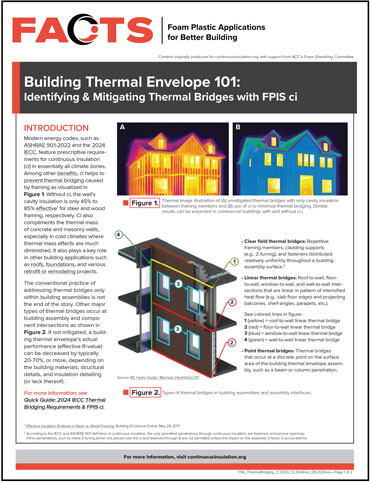
Thermal bridges are areas of a building enclosure that allow heat to bypass insulation and flow more easily through structural elements such as wood studs, steel studs, floor lines, and other framing components. These pathways can significantly reduce the real-world thermal performance of walls and roofs, increase energy costs, and contribute to moisture-related durability concerns. This FACTS Sheet explains how foam plastic insulating sheathing (FPIS) continuous insulation (ci) helps identify, reduce, and mitigate thermal bridging in residential and commercial construction.
Key Takeaways
- Thermal bridging can substantially reduce the effective R-value and energy performance of building assemblies.
- Common thermal bridges occur at framing members, structural penetrations, floor slabs, balconies, and building connections.
- FPIS ci helps create a more continuous thermal boundary by covering framing members and reducing heat flow through the building envelope.
Frequently asked questions
What is thermal bridging?
Thermal bridging occurs when a building material with a relatively high rate of heat transfer, such as wood, steel, concrete, or masonry, creates a pathway through the insulation layer. These pathways allow heat to flow more easily through the building enclosure, reducing overall energy efficiency and creating localized temperature differences.
Why is thermal bridging a concern for building performance?
Thermal bridging can increase heating and cooling loads, reduce occupant comfort, and lower the effective thermal performance of walls and roofs. In some cases, colder interior surface temperatures caused by thermal bridges can contribute to condensation risks and moisture-related durability issues within building assemblies.
How does FPIS continuous insulation (ci) help mitigate thermal bridging?
FPIS ci is installed continuously across the exterior side of framing and other structural elements, creating a more uniform thermal layer. By covering framing members that would otherwise conduct heat through the assembly, FPIS reduces thermal bridging, improves whole-wall performance, and helps buildings achieve higher levels of energy efficiency.