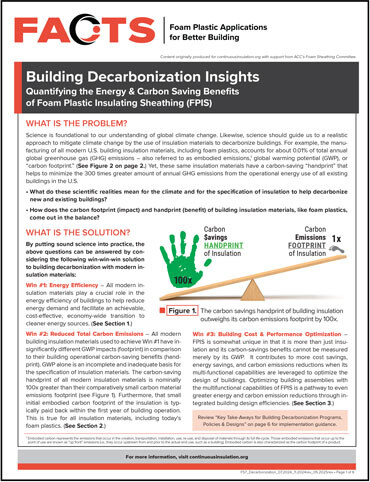
Building decarbonization requires reducing both energy consumption and greenhouse gas emissions. This fact sheet explains why insulation plays a critical role in that effort and demonstrates how foam plastic insulating sheathing (FPIS) delivers carbon-saving benefits that significantly outweigh its embodied carbon footprint. By improving energy efficiency and optimizing building performance, FPIS helps reduce operational emissions while supporting affordable, resilient, and sustainable buildings.
Key Takeaways
- The operational carbon savings delivered by insulation over a building's life are substantially greater than the embodied carbon associated with manufacturing the insulation.
- Energy efficiency is a foundational strategy for building decarbonization because it reduces energy demand, lowers emissions, and supports building electrification.
- FPIS provides additional carbon-saving opportunities through its multifunctional capabilities, helping optimize building enclosure performance, cost, and energy efficiency.
A single page "Special Report" and presentation slide deck are also available based on this FACTS Sheet content:
Download SPECIAL REPORT PRESENTATION: PPT PDF
Frequently asked questions
Why is insulation important for building decarbonization?
Insulation reduces heating and cooling energy demand, making buildings more efficient and lowering operational greenhouse gas emissions. Because energy efficiency reduces emissions regardless of the energy source used, insulation is one of the most effective and cost-efficient tools available for building decarbonization.
How does the carbon footprint of FPIS compare to its carbon-saving benefits?
While FPIS has an embodied carbon footprint associated with its manufacture, the energy savings it provides throughout a building's service life generate far greater carbon reductions. The FACTS sheet explains that the carbon-saving "handprint" of modern insulation materials can exceed their embodied carbon footprint by roughly two orders of magnitude over the life of a building.
How does FPIS help maximize energy and carbon savings?
FPIS is more than a thermal insulation product. Its ability to contribute to multiple building enclosure functions can improve overall assembly performance and enable more efficient building designs. These integrated design benefits can lead to additional energy savings, lower operating costs, and greater reductions in lifetime carbon emissions.