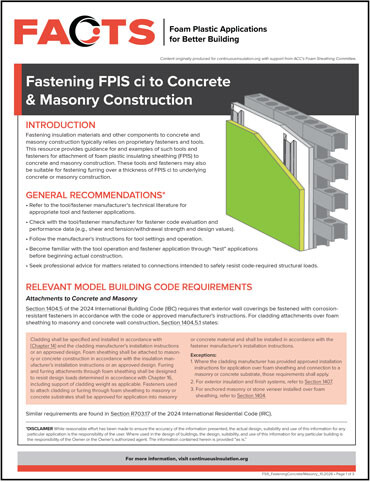
Introduction
Attaching foam plastic insulating sheathing (FPIS) to concrete and masonry construction requires selecting fastening systems that provide secure attachment while maintaining the performance of the building enclosure. This FACTS Sheet provides an overview of common fastening approaches, installation tools, and fastener options used to install continuous insulation (ci) over concrete and masonry substrates in residential and commercial construction.
Key Takeaways
- Multiple fastening options are available for attaching FPIS to concrete and masonry construction, including mechanical fasteners designed specifically for these substrates.
- Proper fastener selection depends on factors such as insulation thickness, substrate type, applied loads, and cladding attachment requirements.
- Well-designed fastening systems support the long-term performance of continuous insulation while maintaining constructability and durability.
Frequently asked questions
What types of fasteners are commonly used to attach FPIS to concrete and masonry walls?
Common attachment methods include concrete screws, masonry anchors, insulation fasteners with large washers or plates, and powder-actuated fastening systems where permitted. The appropriate fastener depends on the type of substrate, insulation thickness, and project-specific performance requirements.
How do designers and contractors select the proper fastening system?
Fastener selection should consider insulation thickness, substrate strength, wind loads, cladding attachment requirements, and manufacturer installation guidance. The fastening system must provide adequate attachment strength while supporting the intended building enclosure assembly and long-term service conditions.
Does fastening continuous insulation (ci) to concrete or masonry require specialized tools?
Many FPIS ci installations use common construction tools such as hammer drills, rotary drills, impact drivers, and powder-actuated tools. The required equipment varies based on the selected fastener type and the characteristics of the concrete or masonry substrate being used.