Introduction
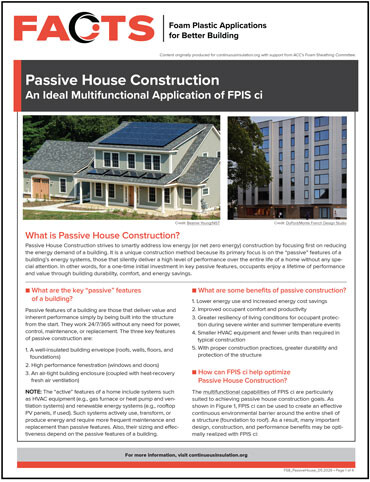
Passive House construction is built around the principle of dramatically reducing building energy use through an exceptionally efficient building envelope. Achieving Passive House performance requires continuous insulation, excellent airtightness, minimized thermal bridging, and robust moisture management. This FACTS Sheet explains how foam plastic insulating sheathing (FPIS) continuous insulation (ci) serves as a multifunctional component that helps designers and builders meet these demanding performance objectives in both residential and commercial buildings.
Key Takeaways
- Passive House buildings rely on highly insulated, airtight enclosures that minimize thermal bridging and energy loss.
- FPIS continuous insulation can perform multiple enclosure functions while helping achieve the high levels of thermal performance required for Passive House design.
- Continuous exterior insulation improves building durability, comfort, energy efficiency, and moisture management while simplifying high-performance wall assemblies.
Frequently asked questions
Why is continuous insulation important for Passive House construction?
Continuous insulation (ci) is a fundamental Passive House strategy because it creates a more complete thermal boundary around the building. By reducing heat flow through framing and other structural components, continuous insulation improves overall building efficiency and helps achieve the low energy demand targets required for Passive House certification.
How does FPIS ci help reduce thermal bridging in Passive House assemblies?
FPIS ci is installed continuously across the exterior of the structure, covering framing members and other potential thermal bridges. This continuous layer of insulation reduces unwanted heat transfer through the enclosure and improves the effective thermal performance of the wall or roof assembly.
What makes FPIS a multifunctional solution for high-performance buildings?
In addition to providing continuous insulation, FPIS can contribute to air barrier, moisture management, and water-resistive barrier strategies when properly designed and installed. Combining multiple enclosure functions in a single product can simplify construction, improve performance, and support the demanding enclosure requirements of Passive House projects.