CLIMATE ZONE 4 (except Marine)
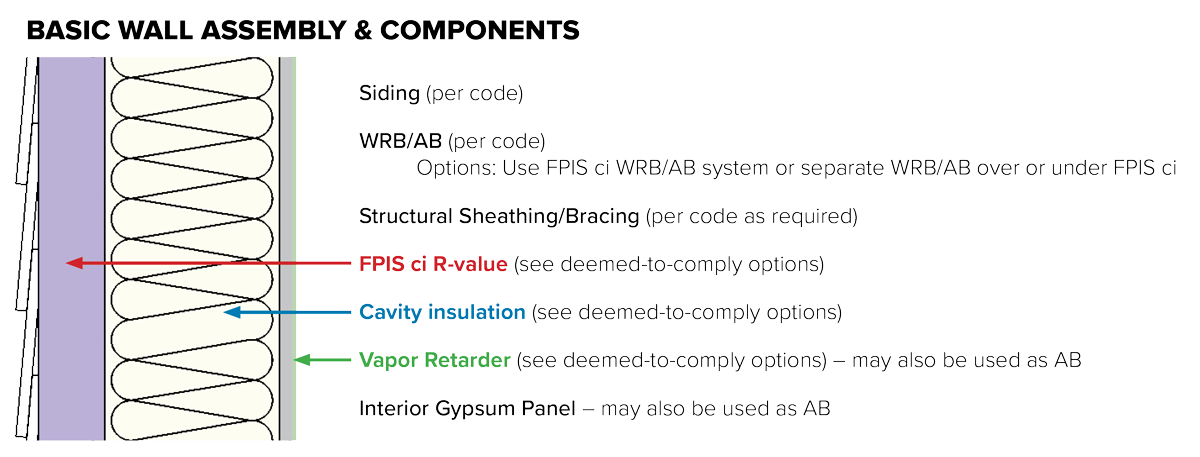
Wood Frame Walls - Commercial Buildings & Group R Buildings >3 stories
Max. | Stud | Min. Stud Spacing | Cavity Insulation | Continuous Insulation (ci) | Recommended Vapor Retarder Options | Wall Assembly | % better than code U-factor |
|---|---|---|---|---|---|---|---|
0.064 | 2x4 | 16" | 0 | 12 | None or Class III | 0.064 | 0% |
11 | 5 | Class III or Class II(r) | 0.063 | 2% | |||
13 | 3.8 | Class III or Class II(r) | 0.064 | 0% | |||
15 | 3 | Class III or Class II(r) | 0.064 | 0% | |||
2x6 | 16" | 0 | 12 | None or Class III | 0.062 | 3% | |
19 | 3.8 | Class III or Class II(r) | 0.051 | 20% | |||
20 | 4 | Class III or Class II(r) | 0.048 | 25% | |||
21 | 4.2 | Class III or Class II(r) | 0.047 | 27% |
Cold-formed Steel (CFS) Frame Walls - Commercial Buildings & Group R Buildings >3 stories
Max. | Stud | Min. Stud Spacing | Cavity Insulation | Continuous Insulation (ci) | Recommended Vapor Retarder Options | Wall Assembly | % better than code U-factor |
|---|---|---|---|---|---|---|---|
0.064 | 3.625" | 16" | 0 | 12.6 | None or Class III | 0.064 | 0% |
11 | 8.5 | Class III or Class II(r) | 0.064 | 0% | |||
13 | 7.5 | Class III or Class II(r) | 0.064 | 0% | |||
15 | 7.2 | Class III or Class II(r) | 0.064 | 0% | |||
≥5.5" | 16" | 0 | 12.6 | None or Class III | 0.064 | 0% | |
19 | 7 | Class III or Class II(r) | 0.064 | 0% | |||
20 | 6.3 | Class III or Class II(r) | 0.064 | 0% | |||
21 | 6.3 | Class III or Class II(r) | 0.064 | 0% |
Additional Climate Zones:
Return to Ready-to-Use FPIS ci and Vapor Retarder Options for Above-Grade Walls
NOTES
NOTE 1: Cavity insulation material R-values shown are maximums and represent commonly used air/vapor-permeable products such as fiberglass batts/blown, cellulose, and open-cell spray foam. Check manufacture data or product label for actual R-values.
NOTE 2: Continuous insulation R-values are minimums. Using a greater ci R-value will result in lower wall assembly U-factor for above-code thermal compliance and improved moisture control. All types of FPIS ci may be used provided the minimum ci R-values are satisfied or exceeded. To determine required thickness of ci refer to FPIS manufacturer R-value data for the specific foam sheathing type and brand. For approximate purposes, the thickness of FPIS ci can be determined by dividing the required R-value by: 4 R/in (EPS - expanded polystyrene); 5 R/in (XPS - extruded polystyrene; or 6 R/in (polyisocyanurate).
NOTE 3: Interior vapor retarder recommendations are per code and vary depending on climate and insulation ratio. Insulation ratio is the ratio of ci R-value to cavity R-value and the greater this ratio the less thermal bridging impacts the thermal performance of the assembly (e.g., higher effective R-value for total amount of insulation used) and the better moisture is controlled. Interior vapor retarders options for use on walls with FPIS ci as indicated in the table are specified per code to ensure adequate interior drying potential while the insulation ratios control wetting potential. For some assemblies in some climate zones, the code may allow for more vapor retarder options than indicated. But, a maximum of two options are shown that represent an optimal combination of performance and cost.
The vapor retarder options featured in the table are described as follows:
None: No interior vapor retarder required (low perm paints or other interior wall finishes < 3 perms should not be used in CZ 0-2 for any wall including those with or without FPIS ci on the exterior). Where no vapor retarder is feasible it provides the maximum inward drying potential for a wall.
Class III vapor retarder: Vapor retarder paint on interior gypsum applied in accordance with the paint manufacturer's installation instructions to achieve a perm rating of >1 to 10 perms, except where indicated in the table as requiring > 3perms (but still not more than 10 perms) for CZ 0-2.
Class II(r) vapor retarder: A Class II responsive vapor retarder with a standard "dry" perm rating of >0.1 perms to 1 perm and a standard "wet" perm rating of > 1 perm per code (e.g., asphalt Kraft paper).
Class I(r) vapor retarder: A Class I responsive vapor retarder with a standard "dry" perm rating of not greater than 0.1 perm and a standard "wet" perm rating of typically >> 1 perm (e.g., proprietary membranes).
TIP: Where a Class I(r) or II(r) vapor retarder is indicated, either a Class I(r) or Class II(r) vapor retarder may be used. However, a Class I(r) vapor retarder will tend to decrease wetting potential and increase drying potential above that possible with a Class II(r) vapor retarder. Also, neither create a "double vapor barrier" assembly when used together with FPIS ci per code. Thus, use of a Class I(r) or II(r) vapor retarder does not trap moisture and promotes drying because these vapor retarders are responsive and become more "vapor open" or permeable to allow drying to the interior. While not required by code for walls without exterior continuous insulation, these types of responsive vapor retarders are perhaps more critical to durable performance of such walls in cold climates (e.g., in climate zones 5-8 a Class I(r) vapor retarder is highly recommended for such walls).
NOTE 4: Where the selected assembly's U-factor is better (lower) than the code's required maximum U-factor, a positive percentage better than code is indicated. Where the value is 0% the assembly is essentially equivalent to the minimum code requirement. Where any wall assembly has a positive percentage above code, it's performance can be used to trade-off energy performance of other building assemblies and systems or can be used to support a design objective for above-code performance.
DISCLAIMER: This information is provided "as is." It is the user's responsibility to determine suitability for use and compliance with locally applicable building and energy codes, and to seek professional assistance as appropriate.