This “ready-to-use” resource provides a selection of practical and code-compliant options for FPIS ci and vapor retarders appropriate to each U.S. climate zone for above-grade walls of wood- or steel-framed construction. Other wall assembly components must be specified according to the code as required.
The featured “ready-to-use” solutions comply with the above-grade wall prescriptive insulation requirements of the 2024 IECC Section C402 for commercial and multifamily buildings,* or with Section R402 for residential one- and two-family dwellings (or Chapter 11 of the 2024 IRC) as applicable. The insulation options are paired with vapor retarder options complying with the 2024 International Building Code (IBC) (see Section 1404.3) and International Residential Code (IRC) (see Section R702.7). In some cases, the energy code minimum requirements are exceeded in order to satisfy the building code’s vapor retarder provisions.
These “ready-to-use” solutions were developed using ABTG's calculators for wood-frame and steel-frame above-grade wall assemblies. The user may apply these tools to help evaluate many other solutions. The wall assemblies featured below use the calculators’ default assumptions for the R-value of building materials other than insulation (e.g., 5/8" gypsum panels on interior and exterior side of steel frame walls; 7/16" OSB and 1/2" gypsum panels on exterior and interior of wood frame walls; stucco cladding on steel frame walls and vinyl siding on wood frame walls; etc.).
*The featured solutions may meet or exceed ASHRAE 90.1-2022 requirements; user should confirm code compliance in all cases.
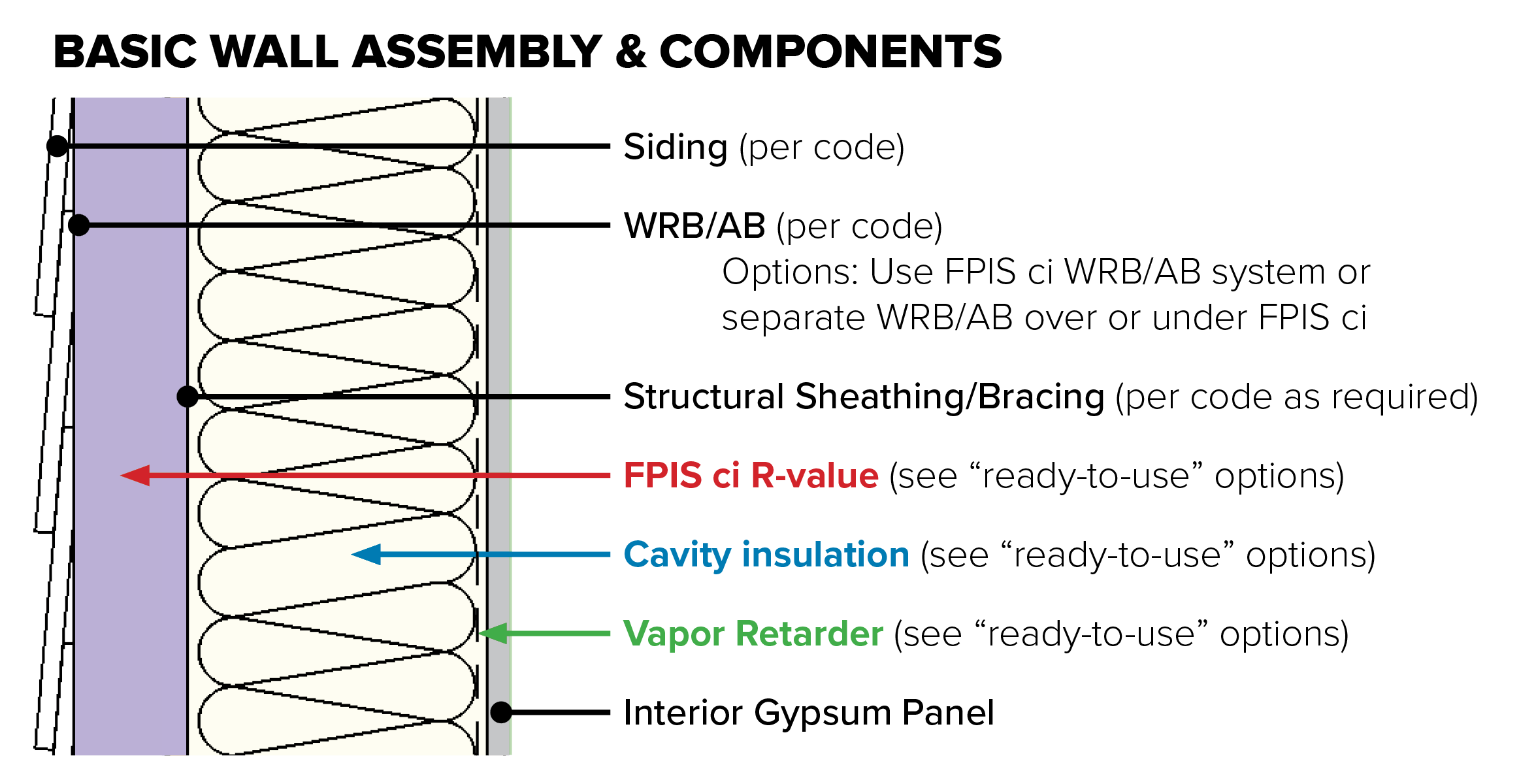
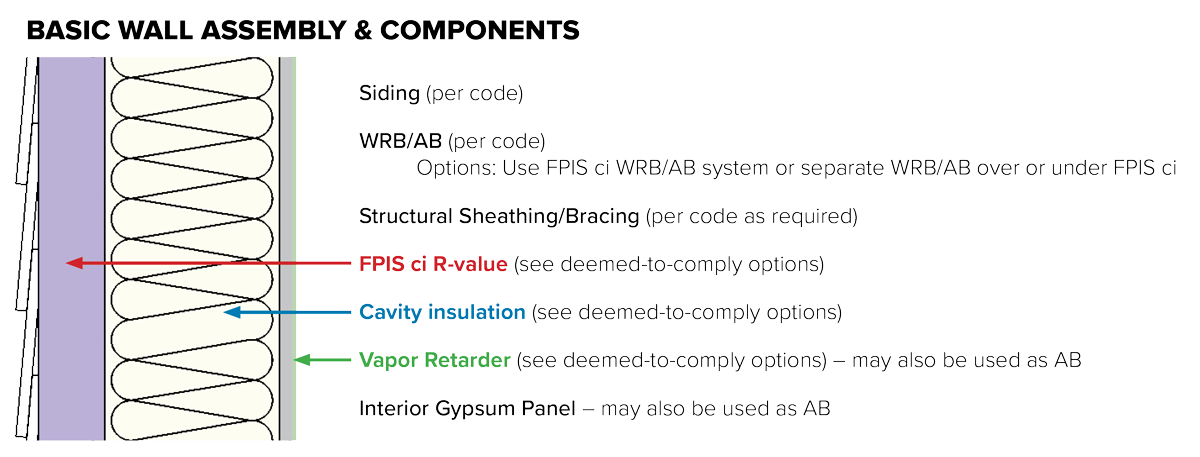
Key Terms to Know:
foam plastic insulating sheathing (also known as "foam sheathing" or "rigid board insulation")
continuous insulation; it is defined by the code as “insulating material that is continuous across all structural members without thermal bridges other than fasteners and service openings.” For the purpose of this resource, it is located on the exterior side of an above-grade frame wall assembly.
insulating material located between framing members
interior vapor retarder (warm-in-winter side of wall)
water-resistive barrier
air barrier
a measure of the ability of water vapor to move through a material (a lower perm rating increasingly retards vapor flow and a higher value increasingly allows vapor flow)
a special class of vapor retarders that increase in vapor permeance as humidity increases (also known as "smart" vapor retarders). For more information, refer to notes provided with the tabulated “ready-to-use” solutions.
categories of vapor retarders based on different ranges of "dry" cup vapor permeance. Lower vapor permeance means greater vapor retardance. For more information, refer to notes provided with the tabulated “ready-to-use” solutions.
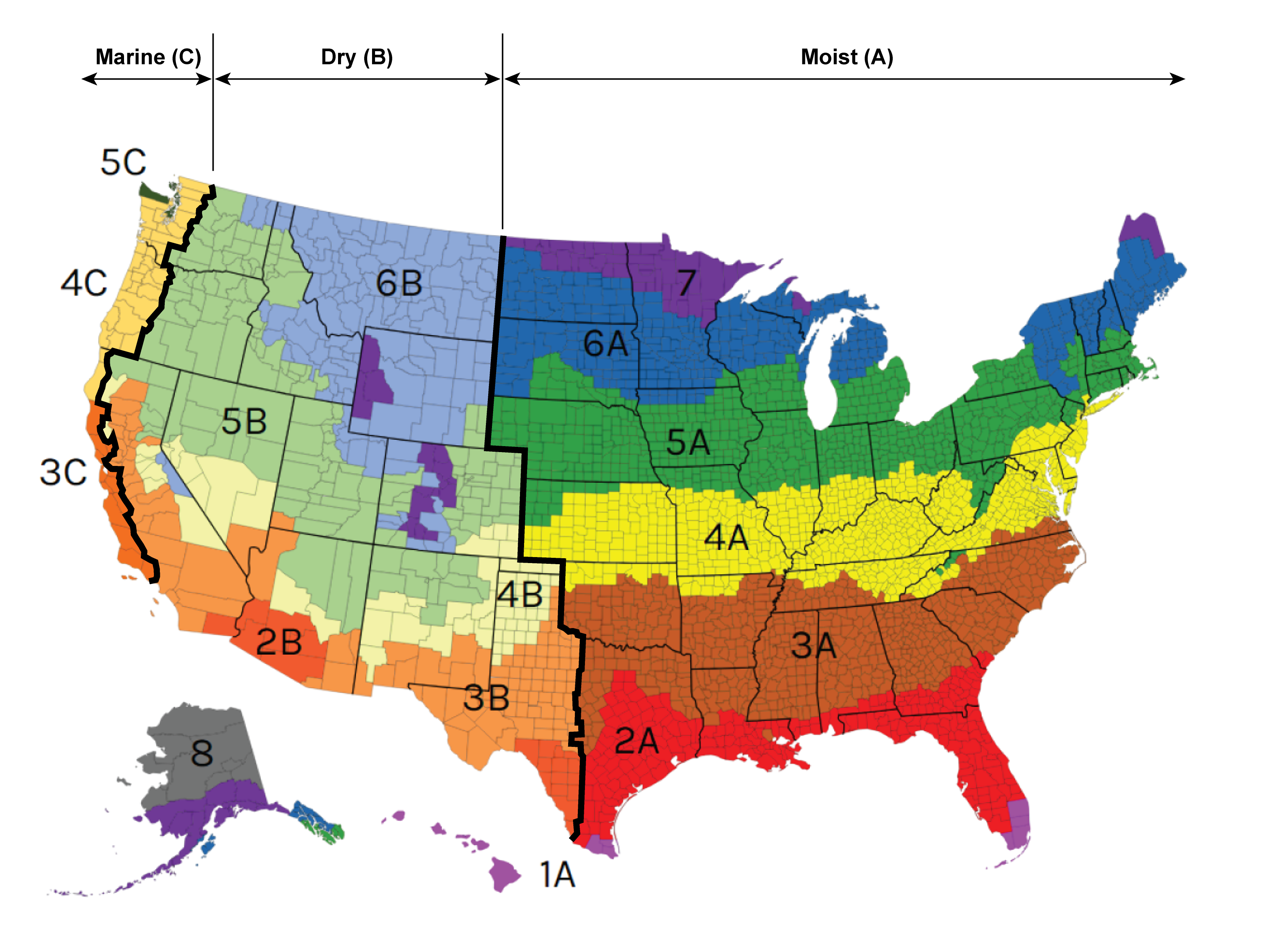
Select your Climate Zone below to see "ready-to-use" solutions for
1 & 2 Family Dwellings and Group R Buildings (3 stories or less)
2024 IECC-R / IRC Ch 11 READY-TO-USE WOOD FRAME WALLS BY CLIMATE ZONE
Select your Climate Zone below to see "ready-to-use" solutions for
Commercial Buildings and Group R Buildings (>3 stories)
2024 IECC-C READY-TO-USE WALLS BY CLIMATE ZONE
DISCLAIMER: This information is provided "as is." It is the user's responsibility to determine suitability for use and compliance with locally applicable building and energy codes, and to seek professional assistance as appropriate.