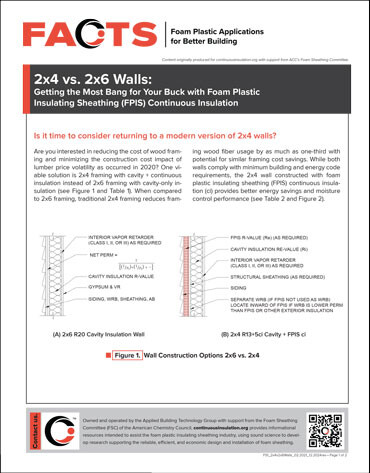
When designed to meet modern energy codes, a 2x4 wall with cavity insulation and foam plastic insulating sheathing (FPIS) continuous insulation (ci) can outperform a traditional 2x6 wall with cavity-only insulation. This FACTS Sheet explains how 2x4 walls with continuous insulation can reduce lumber use, lower framing costs, improve thermal performance, and provide superior moisture control, while complying with residential building and energy codes.
Key Takeaways:
- A 2x4 wall with cavity insulation plus FPIS ci can meet energy code requirements while using less lumber.
- Continuous insulation reduces thermal bridging and can improve wall energy performance compared to cavity-only insulation systems.
- FPIS ci enhances moisture control and can provide effective water-resistive barrier performance when properly installed.
Frequently asked questions
Why would a builder choose a 2x4 wall with continuous insulation instead of a 2x6 wall?
A 2x4 wall with R-13 cavity insulation plus R-5 continuous insulation can meet the same code requirements as a 2x6 wall with R-20 cavity insulation while using significantly less lumber. In many applications, the 2x4 approach reduces framing material use by as much as one-third, potentially lowering construction costs while maintaining code compliance.
Does a 2x4 wall with continuous insulation perform as well as a 2x6 wall for energy efficiency?
Yes. The FACTS Sheet shows that a 2x4 wall with R-13 cavity insulation and R-5 continuous insulation achieves a lower U-factor (0.057) than a 2x6 wall with R-20 cavity insulation (0.060). Because continuous insulation reduces thermal bridging through framing members, the wall can deliver better overall thermal performance despite having less cavity insulation.
How does continuous insulation improve moisture management?
Continuous insulation helps keep wall sheathing warmer and drier, reducing the risk of moisture accumulation within the wall assembly. The FACTS Sheet highlights field testing that shows walls with R-5 FPIS continuous insulation maintained dry OSB sheathing, while comparable cavity-only insulated walls experienced elevated moisture levels. FPIS can also function as a high-performing water-resistive barrier when properly detailed and installed.