Introduction
Moisture control is one of the most important factors affecting the durability, energy efficiency, and long-term performance of building envelopes. This FACTS Sheet explains how foam plastic insulating sheathing (FPIS) continuous insulation (ci) can help designers and builders create more robust wall assemblies by controlling condensation, managing water vapor movement, and improving the overall moisture performance of the enclosure. When properly designed and installed, FPIS ci can support walls that are both energy efficient and resilient across a wide range of climate conditions.
Key Takeaways
- Moisture problems often occur when wall assemblies allow condensation to form inside critical building components.
- FPIS ci helps keep wall assemblies warmer, reducing the potential for condensation and moisture accumulation.
- Proper coordination of insulation, vapor control, water management, and drying potential creates more durable and reliable wall systems.
Frequently asked questions
Why is moisture control important in wall assemblies?
Excess moisture can lead to material deterioration, reduced insulation performance, mold growth, and shorter building service life. Effective moisture control strategies help protect structural components, maintain energy efficiency, and improve the long-term durability of the building enclosure.
How does FPIS continuous insulation (ci) improve moisture performance?
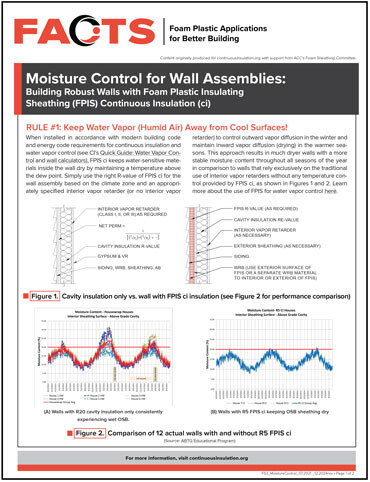
FPIS ci is installed outside the framing and structural sheathing, helping keep these components warmer during cold weather. By increasing sheathing temperatures, continuous insulation reduces the likelihood that water vapor will condense within the wall assembly, lowering the risk of moisture-related damage.
Can wall assemblies be designed to provide both energy efficiency and moisture control?
Yes. Modern wall designs can achieve both objectives when thermal insulation, vapor control, water management, air leakage control, and drying potential are considered together. FPIS ci is often used as part of an integrated building enclosure strategy that improves both thermal performance and moisture management.