Introduction
Proper water vapor control is essential to achieving durable, energy-efficient wall assemblies. Moisture accumulation caused by vapor diffusion can contribute to condensation, reduced thermal performance, and long-term durability concerns if wall assemblies are not properly designed for the climate and construction type.
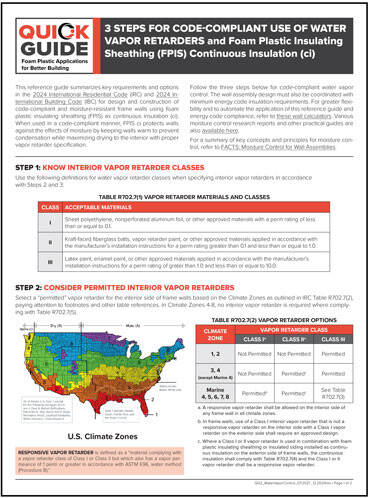
Foam Plastic Insulating Sheathing (FPIS) continuous insulation (ci) can significantly improve moisture management by keeping wall assemblies warmer and reducing the potential for condensation within wall cavities. The 2024 International Residential Code (IRC) and 2024 International Building Code (IBC) provide multiple pathways for achieving code-compliant vapor control when using FPIS ci. This Quick Guide summarizes the key requirements and practical design options for moisture-resistant frame wall construction.
Key Takeaways
- The 2024 IRC (Section R702.7) and 2024 IBC (Section 1404.3) provide multiple code-compliant options for managing water vapor in frame wall assemblies that use FPIS continuous insulation.
- Continuous insulation can reduce condensation risk by warming wall cavity components and shifting the dew point outward within the assembly.
- Proper vapor retarder selection depends on climate zone, insulation configuration, and wall assembly design rather than a one-size-fits-all approach.
Key Definitions
Water vapor retarder: A water vapor retarder is a material or system that limits the movement of water vapor through a building assembly. Vapor retarders are classified according to their permeance and may be required in specific climate zones and wall assemblies.
Water vapor diffusion: Water vapor diffusion is the movement of moisture vapor through building materials from areas of higher vapor pressure to lower vapor pressure. Managing diffusion is an important part of moisture control in wall assemblies.
Continuous insulation (ci): Continuous insulation is insulation that runs continuously across structural framing members, reducing thermal bridging and improving the overall thermal performance of the building enclosure.
Frequently asked questions
When is a vapor retarder required in walls that use FPIS continuous insulation?
The answer depends on the climate zone, wall assembly design, and amount of continuous insulation used. Both the 2024 IRC and IBC provide exceptions that allow reduced vapor retarder requirements when sufficient continuous insulation is installed outboard of the wall framing to control condensation.
How does FPIS continuous insulation (ci) improve moisture management?
FPIS ci helps maintain warmer temperatures within wall framing cavities, reducing the likelihood that moisture-laden air or vapor diffusion will result in condensation on cold surfaces. This can improve wall durability while supporting energy efficiency goals.
What are the three basic steps for code-compliant water vapor control using FPIS ci?
Designers should first determine the applicable climate zone and code requirements, then evaluate the wall assembly and continuous insulation levels needed for condensation control, and finally select an appropriate vapor retarder strategy that complies with IRC or IBC requirements.
Steps
-
Determine the applicable climate zone and code requirements.
Identify the project location and determine which vapor retarder and condensation control provisions apply under the IRC or IBC.
-
Evaluate condensation control needs.
Assess wall assembly components, insulation levels, and potential condensation planes within the assembly.
-
Select exterior FPIS continuous insulation levels.
Provide sufficient continuous insulation to maintain temperatures within the wall assembly above condensation thresholds as required by the applicable code provisions.
-
Choose a compliant vapor retarder strategy.
Select the vapor retarder class and placement appropriate for the climate zone, wall assembly, and continuous insulation configuration.
-
Coordinate enclosure control layers.
Ensure compatibility between the vapor retarder, water-resistive barrier, air barrier, and insulation systems.
-
Verify code compliance.
Confirm that insulation levels, vapor control strategy, and wall assembly details satisfy all applicable IRC or IBC requirements.
For additional guidance on details and options for code-compliant moisture control, refer to this wall assembly illustration.