 |  |  |
Multi-functional applications of FPIS ci is particularly suited for above-grade walls. It serves as continuous insulation and can be used as an air barrier material to meet energy code requirements. Simultaneously, it can be used to satisfy many building code functional requirements including water-resistive barrier (WRB) and as a means for water vapor control in coordination with the use of appropriate water vapor retarders. Refer to the Design Guide for Above-grade Walls with FPIS ci to step through the process of making code-compliant decisions for the use of FPIS ci on building exterior walls, including consideration of fire performance requirements. In addition, the ANSI/ABTG FS200.1 Standard provides multi-functional guidance on the code-compliant applications of FPIS ci for above grade walls.
The following is a brief summary of some above-grade wall applications and additional considerations, including helpful resources.
Wood and Steel Frame Walls
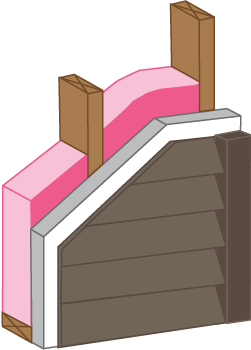
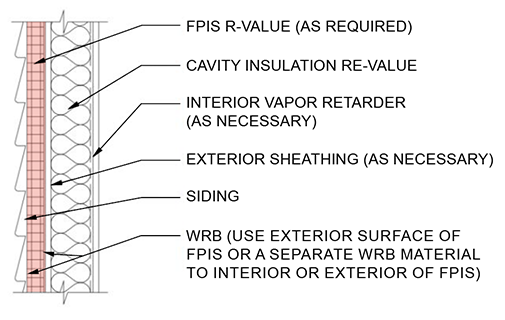
FPIS ci is used to insulate wood and cold-formed steel frame walls to satisfy the energy code for thermal performance while addressing many other building code functional requirements such as water vapor control, water-resistive barrier, and air barrier. For steel frame walls, the use of ci is a practical necessity in all climates to mitigate thermal bridging of framing members that otherwise cut the thermal value of cavity insulation in half. Prescriptive ci R-value requirements for wood and steel frame walls can be found in IECC Section C402.1.3 and IECC Section R402.1.3 or determined with the Wood Frame Wall Calculator or the Steel Frame Wall Calculator. The two approaches to use FPIS ci on frame walls are shown in the figures below.
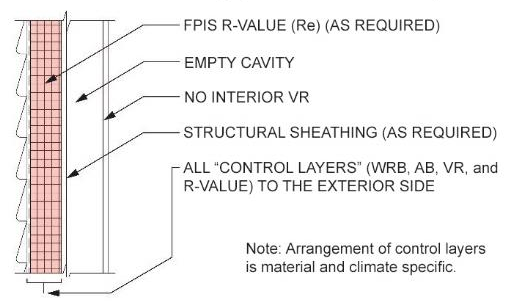
Mass Walls
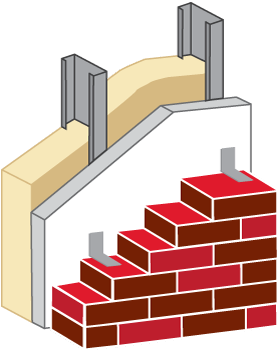
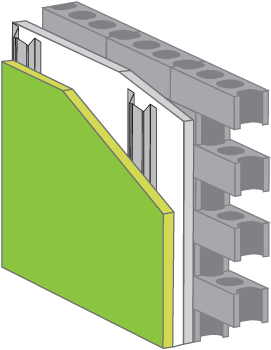
FPIS ci can be located on the interior side, integral to (e.g., insulated precast concrete sandwich panels), or exterior side of mass walls, usually of concrete or masonry construction. It has commonly been used on the exterior side of masonry cavity walls (i.e., located in the cavity between an exterior masonry veneer and the masonry structural wall). Foam plastic insulating concrete forms (ICFs) can also be used to provide continuous insulation for cast-in-place concrete walls. Prescriptive energy codes prominently feature the use of ci to insulate these types of mass walls (see IECC Section C402.1.3).
CLT Wood Mass Walls
Cross-laminated timber (CLT) walls have become more popular in recent years for low- to mid-rise commercial building construction. Where used in buildings complying with Type V construction (allowing use of any code-compliant material, including combustible materials like wood), FPIS ci can be used on exterior walls of CLT construction, just as with traditional wood frame walls more commonly associated with Type V construction. The prescriptive insulation requirements for these solid wood “mass” walls are the same as mentioned above for concrete/masonry mass walls. Where the building is designed in compliance with Type IV construction limits (e.g., area and height limits that exceed that of Type V construction), more stringent requirements for or exclusions of combustible materials on CLT construction apply along with requirements like encapsulating the CLT structure with layers of gypsum sheathing on both sides.
Metal Buildings
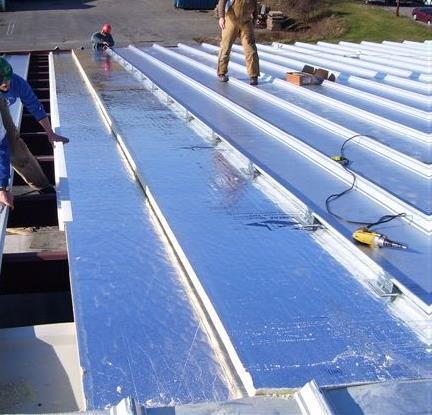
FPIS ci can be located on the exterior side of metal buildings sandwiched between purlins (roof) or girts (walls) and the metal cladding for improved thermal performance with reduced thermal bridging and condensation risk. An example of such an installation is shown in Figure 3.
Additional Considerations
- FPIS ci and Thermal Bridging: New energy code requirements for thermal bridging apply to buildings of steel frame and mass (concrete/masonry) wall construction. These new provisions require specialized detailing at the following conditions to minimize thermal bridging: roof-wall intersections (e.g., parapets), window-wall intersections, cladding supports (e.g., offset shelf angles and cladding support rails/furring), and floor-to wall intersections (e.g., balconies and floor edges). Refer to the IECC Section C402.7 for prescriptive detailing requirements to mitigate thermal bridging at these locations. Use of FPIS ci with these detailing provisions offers one of the more cost-effective and practical ways to address thermal bridging.
- Cladding Connections Through FPIS ci: Cladding materials and furring can be supported on the surface of FPIS ci and attached through it to the underlying structure. Building codes include prescriptive fastening options for this purpose. Refer to IBC Section 1404.5 and IRC Section R703.15.
Helpful Resources
- ANSI/ABTG FS 200.1 "Standard for Use of Foam Plastic Insulating Sheathing (FPIS) in Building Envelopes: Above-grade Walls"
- Design Guide for Above-grade Walls with FPIS ci
- ci for Residential Walls
- ci for Commercial Walls
- Thermal Bridging Prevention
- Fire Performance
- Wall Assembly Calculators
- Cladding Connections
Back to Multifunctional Applications
See Also: Roofs • Floors • Windows • Foundations